
CAP (Creativity Assessment Packet) Test
The Creative Assessment Packet (CAP) Test is a group assessment used to evaluate students in grades 1 – 12 for creative abilities. These differ from cognitive abilities evaluated on IQ tests or academic skills assessed on state achievement tests. The CAP Test focuses more on divergent vs. convergent thinking.

TESTINGMOM The Trusted Leader in Gifted Test Prep
- 1M+ families helped
- 15+ years supporting test prep families
- Created by Karen Quinn, The Testing Mom, the foremost expert on gifted tests

What Is Included in the CAP (Creativity Assessment Packet)?
The Creativity Assessment Packet (CAP) was developed to measure creativity from multiple perspectives rather than relying on a single test. Unlike traditional cognitive assessments, the CAP evaluates creative thinking, creative behaviors, and creative self-perception using three complementary instruments.
Together, these assessments provide educators with a well-rounded picture of a student’s creative potential.
1. Williams Scale
The Williams Scale is completed by both a parent and a teacher who know the student well.
Rather than testing academic knowledge, this rating scale evaluates behaviors and personality traits commonly associated with creativity. Research has shown that creative children often exhibit characteristics that differ from those of their peers, and these behaviors can be observed in everyday situations.
The questionnaire measures qualities such as:
- Curiosity
- Imagination
- Originality
- Willingness to take intellectual risks
- Flexibility in thinking
- Sense of humor
- Persistence
- Interest in solving problems in new ways
Because the scale is completed by adults who regularly interact with the child, it provides valuable insight into how creativity is expressed both at home and at school.
2. Exercise in Divergent Feeling
The Exercise in Divergent Feeling (EDF) is a student self-assessment designed to measure students’ views of their creative attitudes, feelings, and behaviors.
Students respond to approximately 50 statements by selecting one of several response choices (such as Yes, Maybe, No, or Can’t Decide, depending on the version administered).
Questions encourage students to reflect on characteristics commonly associated with creativity.
Examples include statements such as:
- I enjoy thinking of new ways to solve problems.
- I like trying ideas that are different from everyone else’s.
- I enjoy using my imagination.
Students are encouraged to answer honestly rather than trying to guess the “right” answer. Choosing responses that accurately reflect their personality provides the most meaningful results.
3. Exercise in Divergent Thinking
The Exercise in Divergent Thinking (EDT) is the performance portion of the CAP and is often considered its most recognizable component.
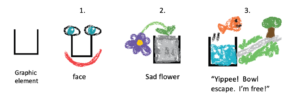
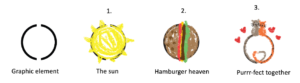
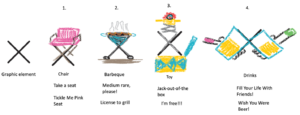
Students receive a page containing 12 simple graphic designs or abstract figures. Their task is to transform each figure into a unique and creative drawing.
After completing each drawing, students create a title or caption that describes or enhances their picture.
This assessment measures both:
- Visual-spatial creativity through the drawings
- Verbal creativity through the titles
Students are encouraged to think beyond the obvious and create original ideas rather than common or expected responses.
Depending on the version administered, students are generally given approximately 20 to 25 minutes to complete all twelve drawings.
Here are a few examples:
Tips and Tricks for Creativity Exercises:
- Encourage your child to think of different types of pictures to draw from one image to the next. Mix up animals, machines, symbols, and landscapes instead of creating all-animal or all-people pictures.
- If your child stays entirely within the graphic stimulus or entirely outside the graphic element, encourage them to try making pictures that are both inside and outside the graphic element – the picture should integrate the figure while also completely surrounding it and filling the graphic stimulus.
- Add details to your picture to enhance it and make it more interesting.
- Aim to create pictures that are asymmetrical both inside and outside the graphic figure.
- Avoid titles that are one-word labels for the image. Go for titles that tell us more about the thinking behind the picture. Aim for humor, puns, story, emotion, hidden meanings, and titles that aren’t obvious.
TESTINGMOM The Trusted Leader in Gifted Test Prep
Join the 1 Million+ families who we have helped over the last 15 years.
Want to try us out? Sign up for a free account today and get 100 practice questions.
See if TestingMom.com supports your child’s test by your school district. If you don't see your child's school district listed, check with us! We have practice for other tests as well.
Tell us about your experiences